The Basement Is the New Stadium: Meet the People Actually Keeping Rock Alive
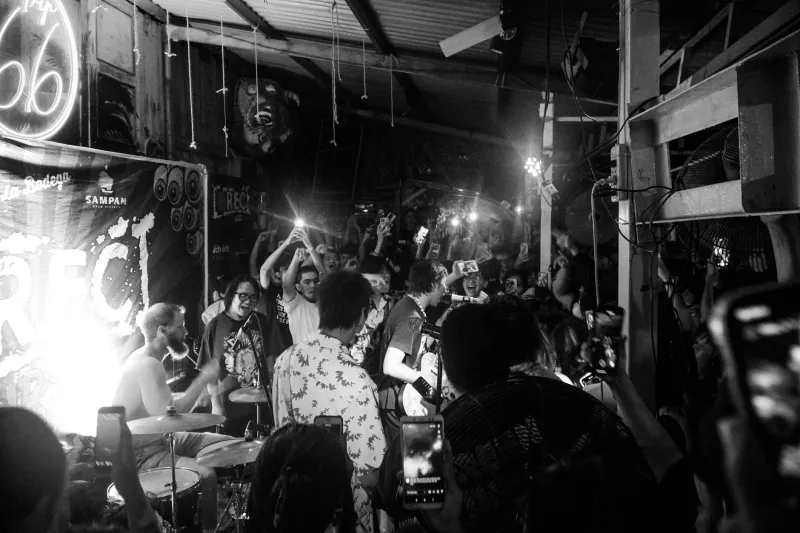
It's eleven o'clock on a Saturday in Richmond, Virginia. There are maybe eighty people packed into a basement that smells like old carpet, ambition, and a misting system that's fighting a losing battle against body heat. A four-piece from Raleigh is setting up gear that probably cost less collectively than a single Ticketmaster service fee. By midnight, the walls will be sweating. By 12:30, three people will have crowd-surfed into a support beam. By 1 a.m., everyone in that room will know the words to songs that aren't on any streaming platform yet.
This is not a nostalgia trip. This is Tuesday in American rock right now.
The Corporate Concert Machine Broke Itself
Before we talk about what's being built in the margins, it's worth being honest about what's been failing in the center. The major venue ecosystem in the United States has spent the last decade making itself increasingly hostile to everyone except the artists who can already fill arenas and the shareholders who profit from the whole miserable apparatus.
Ticket prices that would have seemed obscene a decade ago are now standard. Service fees that sometimes exceed the face value of the ticket itself. Venues that prioritize VIP packages and bottle service over actual sound quality. A consolidation of booking power so extreme that getting on a mid-size venue's calendar without the right management connections has become genuinely difficult for developing acts.
The result is a touring infrastructure that works beautifully for established artists and is functionally useless — sometimes actively predatory — for anyone trying to build something from scratch. Gen-Z artists noticed. And they made a different choice.
"We Didn't Want to Wait for Permission"
Jordan Vasquez has been throwing DIY shows in a converted warehouse space in Kansas City for three years. She's twenty-four. Her space — which she describes only as "somewhere in the West Bottoms" because she'd prefer not to deal with the city's noise ordinance enforcement — has hosted somewhere north of two hundred shows, most of them for acts you haven't heard of yet, some of them for acts you're about to.
"The traditional path was always, you play tiny bars, you get a manager, you get a booking agent, you work your way up," she says. "But bars want a guarantee you'll bring a crowd, managers want to see you already have momentum, booking agents want to see you already have a manager. It's circular. We just decided to skip the whole loop."
What Vasquez and promoters like her have figured out is that the infrastructure itself was always optional. The real thing — the actual human transaction of a band playing music for an audience that gives a damn — doesn't require a venue contract, a PA rental agreement, or a Ticketmaster integration. It requires a space, some people who care, and a willingness to figure out the rest as you go.
The Scene Has a Sound (And It's Regional)
One of the most interesting things happening in the basement and warehouse circuit right now is the emergence of genuinely regional sonic identities — something that was largely flattened by the algorithm-driven music industry of the 2010s, when the pressure to appeal to Spotify's recommendation engine pushed everything toward a kind of geographic homogeneity.
The DIY scenes operating outside that system are developing sounds that are unmistakably rooted in place. There's a strain of swampy, feedback-heavy rock coming out of the Gulf Coast DIY circuit that sounds nothing like what's happening in the Pacific Northwest warehouse scene, which in turn sounds nothing like the angular, post-punk-influenced stuff bubbling up in Rust Belt cities like Cleveland and Pittsburgh.
Marcus Webb, guitarist for a Detroit-based quartet called Hollow Transit, describes it this way: "When you're playing basement shows in Detroit, you're playing for people who grew up on Motown and techno and hardcore, all at once. That gets into the music whether you want it to or not. You can't sound like a band from Portland because you're not a band from Portland. You're from here, and here sounds like this."
Hollow Transit has never played a venue with a proper green room. They have also, in the last eighteen months, built a following of several thousand people across the Midwest who found them through word of mouth, shared show flyers, and a deliberately lo-fi social media presence that feels nothing like a label's content strategy.
The Anti-Infrastructure as Infrastructure
What's fascinating about the current DIY renaissance is how intentional the rejection of traditional infrastructure has become. This isn't just making do with what's available — it's a philosophical position, and the artists operating within it are articulate about why.
"Every time a band we love signs to a label, the first thing that happens is the ticket prices go up and the shows get further away," says Priya Nair, who plays bass in a Chicago noise-rock outfit and helps run a zine that documents the Midwest basement circuit. "We're not anti-success. We're anti the specific version of success that means your fans can't afford to see you anymore."
The tools available to a DIY act in 2024 are genuinely better than they've ever been. Recording gear that would have cost a small fortune a decade ago is accessible. Distribution to streaming platforms is cheap and direct. Social media, for all its algorithmic frustrations, still allows a band to build a real audience without a publicist. The pieces that used to require label infrastructure are either available independently or simply less necessary than the industry always claimed.
What this creates is a touring model built around density rather than scale. Instead of chasing 500-cap venues in twenty cities, acts on the basement circuit play 80-person shows in forty cities, often sleeping on floors, splitting gas money, and building the kind of granular, city-by-city loyalty that translates into a genuinely durable fanbase.
Who's Actually Watching
Here's the part that the major labels are starting to notice, even if they're not sure what to do about it: the basement circuit is functioning as an extraordinarily effective A&R system. The acts coming out of it have already proven they can connect with real audiences in real rooms without any promotional infrastructure. They have battle-tested material. They have communities.
Several acts that started in the DIY circuit over the last few years have fielded label interest and, notably, a meaningful percentage of them have declined or negotiated deals that preserve the things that made them interesting in the first place. The leverage, for once, is with the artist.
"We had a conversation with a label last year," Vasquez says, talking about one of the acts she's helped develop. "They wanted to talk about 'scaling the model.' We told them the model doesn't scale. That's the whole point of the model."
The Sweaty, Beautiful Point
None of this is to suggest that basements are going to replace arenas, or that the major venue ecosystem is going to collapse under the weight of its own service fees (though a girl can dream). The point is simpler and more important than that.
The places where rock music actually gets made — where the next decade's defining acts are currently playing to sixty people who will eventually tell everyone they know — are not the places the industry is watching. They're the places that smell like carpet and ambition. They're the Richmond basements and the Kansas City warehouses and the Chicago living rooms where someone pulled the furniture to one side and set up a PA.
The gatekeepers at the top of the industry are busy optimizing. Down here, people are busy building. And based on what's coming out of those basements right now, the building is going extremely well.