We Unlocked Every Door and Now Nobody Knows Where the Hell They Are
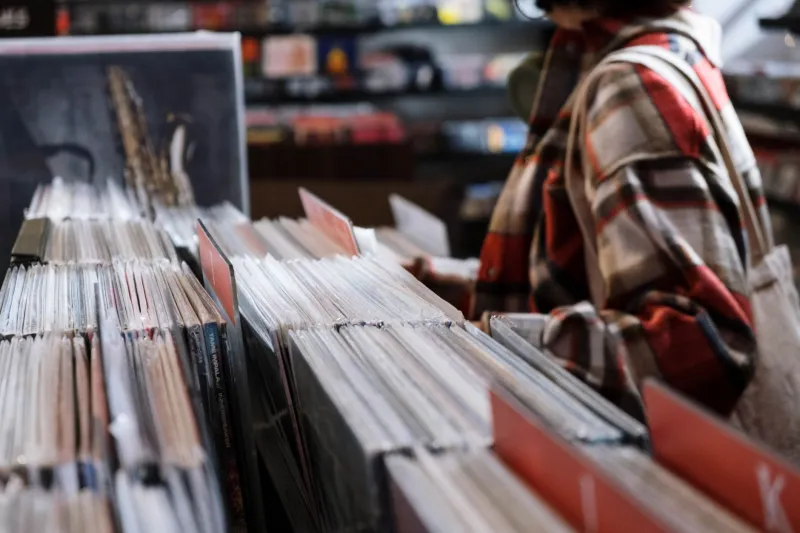
There was a record store in my hometown — and there's one in yours, or there was, or there will be in the nostalgic retelling of your youth that you'll inflict on someone younger than you in about fifteen years. The guy behind the counter knew everything. Not internet-search everything. Everything everything. He knew which pressing of which album had the better mastering. He knew which local band was worth driving forty minutes to see in a Legion hall that smelled like carpet cleaner and disappointment. He knew what you actually meant when you said you kind of liked that one song you heard at your friend's party.
He was also, occasionally, insufferable. He would sigh at your choices. He would recommend things you weren't ready for. He would make you feel, at least briefly, like an idiot — and then you'd go home and listen to whatever he'd pressed into your hands and three weeks later you'd come back having become an entirely different person.
He was a gatekeeper. And gatekeepers, we decided, were the problem.
The Revolution Was Real, and Then It Kept Going
Look, the democratization of music was genuinely, meaningfully good for a while there. The early internet cracked open a world that had been controlled by an absurdly small number of radio programmers, label executives, and music magazine editors whose tastes were presented as universal truth and whose blind spots were enormous. Regional scenes that never got national distribution suddenly had global audiences. Genres that major labels considered unmarketable found their people. Artists who would have spent their entire careers being told no by every industry door they knocked on built real followings without anyone's permission.
That was real liberation, and it would be dishonest to pretend otherwise.
But somewhere in the sprint from "anyone can share music" to "algorithms will surface music perfectly matched to your preferences," something got quietly swapped out. The gatekeepers didn't disappear. They got replaced by something that doesn't have taste, doesn't have context, doesn't have any investment in your growth as a listener, and is optimized entirely around keeping you engaged rather than challenged.
The human gatekeeper, for all their flaws and pretensions and occasionally insufferable record-store energy, had a stake in the culture. The algorithm has a stake in your screen time. These are not the same thing.
The Paradox of Infinite Choice
Here's the part that should bother you: Spotify has approximately 100 million tracks. Apple Music is in the same neighborhood. Every genre, every era, every experimental side project from every artist you've ever loved is technically available right now. The entire recorded history of human musical expression, more or less, sitting in your pocket.
And yet. Study after study, and more importantly, conversation after conversation, reveals that most people are listening to a narrower range of music than they were in the pre-streaming era. The algorithm doesn't take you somewhere new. It takes you somewhere adjacent. It finds the thing that is 15 percent different from what you already like and presents it as discovery. You end up in a feedback loop so refined and so comfortable that you stop noticing you're in one.
This is what the end of gatekeeping actually produced: not a wild frontier of infinite exploration, but a perfectly curated echo chamber dressed up as freedom.
What Getting It Wrong Taught You
Here's the thing nobody wants to admit about the old gatekeeping model: the friction was the point. When you had to dig — through a record store bin, through a friend's recommendation, through a zine review written by someone with strong opinions and limited column inches — you were doing work. And the work had consequences. You'd buy something based on the cover art and it would be completely wrong for you, and you'd either grow into it or sell it back and learn something about your own taste in the process.
You could discover something incorrectly. You could come to a band through the wrong album at the wrong time and have a completely different relationship with their catalog than someone who came in through the approved entry point. That wrongness was generative. It made you a weirder, more particular listener.
Now there's no wrong way in. The algorithm finds the most frictionless path to your existing preferences and walks you down it. There's no resistance, no disorientation, no moment of I have no idea what this is but I'm going to sit with it until I do. Just an endless, frictionless river of content that feels like discovery and functions like stasis.
The Social Media Tastemaker Problem
The vacuum left by traditional gatekeepers didn't stay empty for long. It got filled by influencers, TikTok sounds, and the peculiar new species of music personality who builds an audience not by having deep knowledge but by having good timing. A fifteen-second clip of a song can now define an artist's entire career trajectory, which means the songs that get made are increasingly shaped by what works in fifteen seconds — which is a genuinely terrible way to make rock music, a genre that has historically rewarded patience and volume and the kind of slow build that takes longer than a Reel to pay off.
The new gatekeepers aren't music people. They're content people. And content people optimize for engagement, which is not the same as optimizing for music that matters.
At least the guy at the record store was insufferable in a way that expanded your world. The TikTok algorithm is insufferable in a way that contracts it.
Nobody's Saying Bring Back the Velvet Rope
To be clear: the old system was also broken. It was exclusionary in ways that were often explicitly racist and classist. It locked out entire genres and communities. The people who controlled the gates used that control to protect their own commercial interests as much as any genuine cultural vision. Nostalgia for the gatekeeping era is nostalgia for a system that worked great if you were already inside it.
But the answer to a broken gate isn't no gate. It's a better gate. It's human curation, community-driven discovery, the kind of intentional friction that makes you a more interesting listener rather than a more predictable consumer.
Some of that still exists. Indie record stores. Smaller music blogs with actual personalities. Local radio DJs in markets big enough to still have them. Discord servers where people argue passionately about whether a particular album's second side holds up. These are the places where real discovery still happens, and they are all, without exception, operating against the current.
The doors are all open. The map is gone. And the algorithm is standing at the entrance telling you it knows exactly where you want to go.
Maybe get a little lost on purpose.