Flannel Forever: Rock's Desperate Crawl Back to the 90s and Why It's Quietly Suffocating the Future
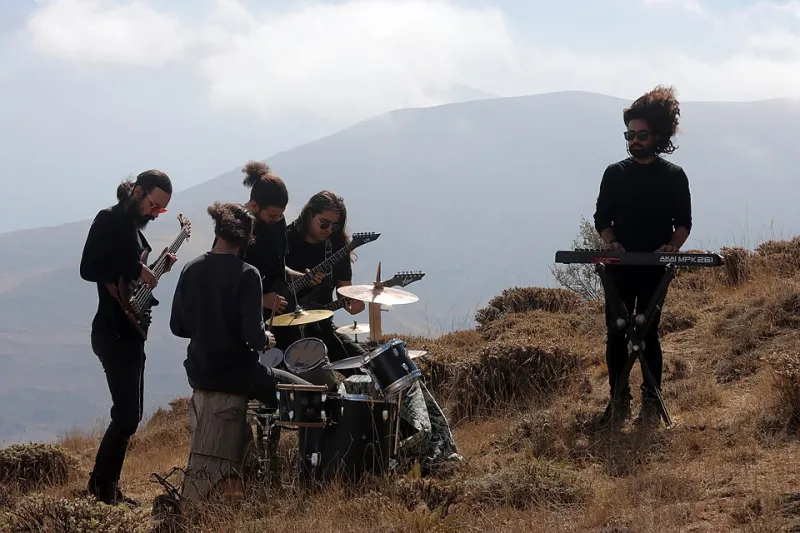
Photo: Mostafameraji, CC0, via Wikimedia Commons
Let's get one thing straight before we go any further: the 1990s were not a perfect decade for rock music. There was plenty of garbage. There were a lot of bands who got famous by doing a slightly worse version of what Nirvana had already done better. There were nu-metal crimes against humanity that we have collectively agreed not to discuss in polite company.
But you wouldn't know any of that from looking at the current rock landscape, where approximately every third new act is performing a loving tribute to an era they were either too young to experience or, in several cases, hadn't been born into yet.
Welcome to the nostalgia trap. The flannel is scratchy, the reverb is excessive, and the exit is nowhere to be found.
The Aesthetic Is Not the Music
Here's where this gets genuinely frustrating rather than just mildly annoying: there's a meaningful difference between being influenced by the past and cosplaying it, and the rock industry has gotten extremely comfortable pretending those two things are the same.
When a band absorbs the emotional directness of Pixies, the dynamic tension of Soundgarden, or the melodic instincts of early Foo Fighters and uses those as building blocks for something that reflects their actual present-tense experience — that's influence. That's how music has always evolved. You eat what came before you and metabolize it into something new.
What's happening with a distressing number of current rock acts is something different. It's the careful selection of signifiers — the tape hiss on the intro, the Butch Vig-adjacent drum sound, the vocalist doing that specific detached-but-passionate delivery that reads as authentically nineties — assembled into a package that communicates a vibe without actually containing one.
The aesthetic is doing the emotional work that the music isn't doing. And audiences, particularly younger ones who didn't live through the original era, are sometimes responding to the signal without realizing the substance behind it has been hollowed out.
Who's Actually Channeling Something Real
This isn't a blanket condemnation. Some artists are doing genuinely interesting things with the gravitational pull of that era.
The bands worth paying attention to are the ones where the retro elements feel like a natural outgrowth of what they're actually trying to say. When a band's specific emotional content — the particular kind of alienation or fury or longing they're working through — genuinely rhymes with the sonic vocabulary of the nineties, the stylistic choice makes sense. The past becomes a useful language rather than a costume.
You can hear it in the specificity. A band that's really channeling something will have weird little choices that don't make commercial sense — a tempo that's slightly too slow, a chord voicing that's slightly too dissonant, a production decision that sacrifices polish for feel. Those rough edges are where the authenticity lives. They're the proof that the artist is following their actual instincts rather than a mood board.
The cynical mining operations look different. Everything is just slightly too right. The flannel is too well-chosen. The production lo-fi is applied with too much precision. The references are too legible. It's the musical equivalent of a chain restaurant that's designed to feel like a local dive — every detail studied and reproduced, the soul conspicuously absent.
Why the Industry Keeps Pushing This Button
The record industry's love affair with Gen X aesthetics isn't accidental or organic. It's a calculated bet, and the math isn't hard to follow.
Millennials and older Gen Z consumers — the people with disposable income and genuine nostalgia — have demonstrated repeatedly that they will open their wallets for things that feel like the music of their formative years. The success of acts like Wet Leg, Boygenius, and others who carry varying degrees of nineties DNA has been noted, catalogued, and is currently being reproduced in development meetings across Los Angeles and Nashville.
Moreover, the nineties aesthetic carries a specific cultural connotation of authenticity that the industry finds commercially useful. Alternative rock was positioned as the anti-commercial option, which means slapping that aesthetic on a product gives it a kind of borrowed credibility. You're not buying corporate rock. You're buying the thing that rejected corporate rock. Except you're buying it from a corporation. The irony is so thick you could spread it on toast.
There's also a risk-management component that nobody talks about openly. Retro-coded rock is easier to pitch, easier to playlist, and easier to explain to the parts of the business that need things explained simply. "It sounds like nineties alternative" is a complete sentence that closes a deal. "It sounds like something that doesn't have a clear reference point yet" is a much harder conversation.
The Actual Cost of Living in the Past
Here's what's genuinely being lost while rock circles back to pay its respects to a decade that ended twenty-five years ago: the present.
Every year spent perfecting the art of sounding like 1994 is a year not spent figuring out what rock sounds like when it's actually engaging with 2025 — with the specific anxieties, the specific joys, the specific sonic environment of right now. The genre is so busy looking in the rearview mirror that it keeps almost missing the turns.
Rock has historically been most vital when it was doing something that felt genuinely threatening to the status quo — not because it was loud, but because it was new. Punk was threatening because nobody had quite heard it before. Grunge was threatening because it smashed through the hair metal establishment with something rawer and more honest. The threat was always in the novelty, the refusal to sound like what already existed.
A genre that's primarily devoted to sounding like what already existed cannot be threatening. It can be comforting, which is a different and much smaller thing.
The Way Out of the Wormhole
None of this means rock has to abandon its history. That would be both impossible and stupid. But there's a difference between a living relationship with the past and a museum exhibit.
The bands that are going to matter — the ones that people will be writing about in twenty years as the acts that kept this thing alive — are going to be the ones who had the guts to sound like themselves even when sounding like themselves was commercially inconvenient. They'll probably have some nineties DNA in there, because that's how influence works. But they'll also have something that couldn't have existed before right now, some element that's irreducibly contemporary.
That's the version of rock worth rooting for. Not the flannel cosplay. Not the carefully engineered tape hiss. Not the aesthetic that's doing twenty years of emotional labor so the music doesn't have to.
The nineties were great. They're also over. Rock's future, if it has one, is going to have to be built out of something other than other people's memories.